Blog

THERMOCALC 3.50 is coming

RP and Eleanor are almost ready to commit to uploading a beta version of THERMOCALC 3.50. This is not all good news for users, since it requires its own axfile format, containing more information and stricter syntax. Nevertheless we’re delighted with it, since, among other things (lots of things under the hood), it features:
  • fully transparent x-eos descriptions in the -it file (i.e. sufficient to implement the x-eos elsewhere)
  • new csv format output for more flexible plotting
  • avT reinstated; both avP and avT now select reactions for their small uncertainties rather than their linearity (had anyone noticed avT was missing?!)
  • more controllable and extensive output from dogmin calcs, dataset extraction mode, and multiple-reaction thermobarometry.

Many users may never have had a copy of version 3.46 or 3.47, so may not yet have discovered the -ic output file. In here, THERMOCALC prints full details of the calculation, including compositional/structural information in terms of molar oxides and site fractions, and numerous thermodynamic variables. What other/different output should we have?
Welcome Simon Schorn!

We’re delighted to welcome Simon to Melbourne, where he began his stay with a trip to Prahran market (left). Simon will be learning about xeos development with Eleanor, aiming to calibrate a single clinopyroxene HPx-eos to replace the three that are currently used in different geological contexts. He will also help to manage this website.

Simon recently gained his PhD, working with Johann Diener at the University of Cape Town, with a thesis entitled High-temperature metamorphism in the western Namaqua-Natal Metamorphic Province (South Africa): implications for low-pressure granulite terranes.

ENKI workshop

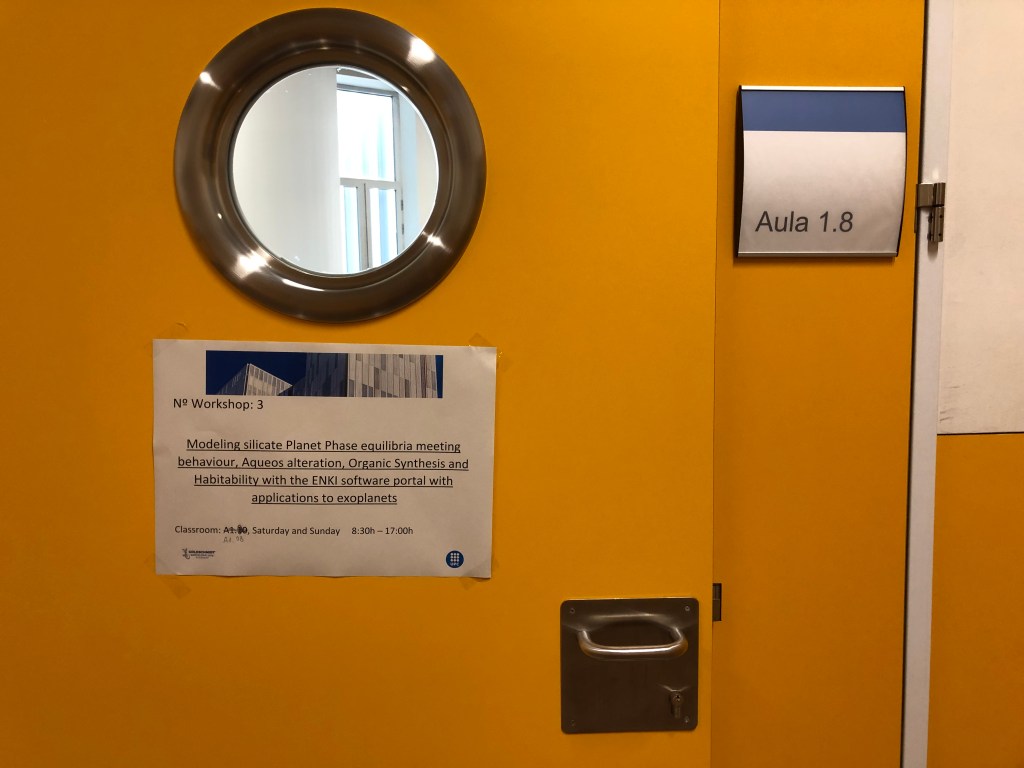
Eleanor is in Barcelona at the pre-Goldschmidt ENKI workshop, run by Mark Ghiorso and Aaron Wolf. ENKI is intended to provide an environment in which thermodynamic datasets and a-x relations can be developed and used in exceedingly flexible ways. So far it seems very promising – an admirable community software project! We will aim to implement the HPx-eos within ENKI.

Modelling experiments at ANU

Eleanor has been at the Australian National University in Canberra visiting Corinne Frigo. Corinne has recently begun a complex program of experiments on the generation of basalt-analogue melts in the CMAS±Cr system. The new igneous set of HPx-eos do not agree too well with Corinne’s initial experiments. This is not really a surprise at this stage, but we have some work to do before we can understand what is wrong.

Corinne is working with Hugh O’Neill, Richard Arculus and Eleanor on ARC Discovery Project DP170100982, A new perspective on melting in the Earth and the origin of basalts. In this project we have the opportunity for close interaction between the experimental program and the internally-consistent modelling work. Enlightening and fun! Corinne will present some of this work at Goldschmidt on 21st August.

Sunset in Australia’s Bush Capital.